


A note from our Editor-in-Chief: I am delighted to welcome Peter Oborne to Zeteo UK as a monthly (from our launch in September onwards) columnist. Support independent journalism and become a paid subscriber to Zeteo UK today.
- Mehdi
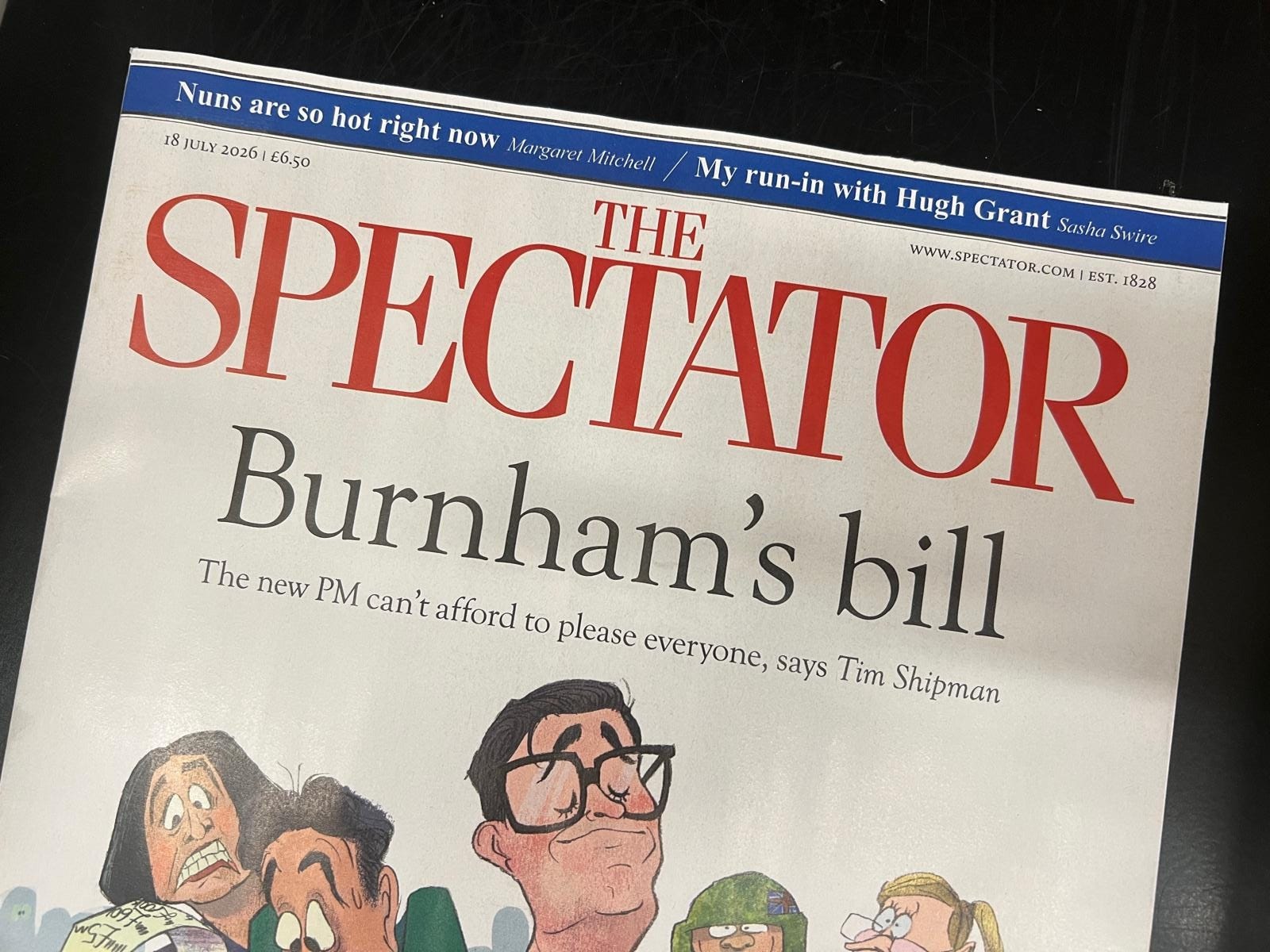
Founded in July 1828 The Spectator is the oldest surviving magazine, not just in Britain but the world. During the course of its magnificent history many British prime ministers have written for it: Lloyd George, Ramsay MacDonald, Harold Macmillan.
Another PM, Boris Johnson, edited it. Great writers from Rudyard Kipling and Evelyn Waugh to Gabriel Garcia Marquez, from TS Eliot and Philip Larkin to Ted Hughes, have been published in its pages. Literary editors have included Graham Greene and Peter Ackroyd. It has given space to public intellectuals, including Bertrand Russell and Noel Malcolm, Ferdinand Mount and William Dalrymple.
The magazine has generally been on the right side of history. Under its founding editor Robert Rintoul, it helped drive through the Great Reform Act of 1832. It supported Robert Peel over the Corn Laws. It was clear-sighted and moral over the First Opium War, one of the most squalid episodes in British imperial history for which Britain is paying a price today. After some dithering, The Spectator backed Abraham Lincoln in the American Civil War when most British papers supported the slave-owning confederate states.
David Butterfield, the magazine’s historian, records the heavy cost: “subscribers fell below a thousand for the first time since the paper’s very early years and the title almost collapsed.” Butterfield also records that The Spectator stood out from much of the British press by seeing straight through Oswald Mosley and calling for a ban on the Blackshirt or any political uniform: “the Blackshirts, like the Daily Mail, appeal to people unaccustomed to thinking. The average Daily Mail reader is a potential Blackshirt ready made.”
Though a Conservative title, The Spectator opposed the Suez invasion, and backed the Wolfenden report, condemning Britain’s “utterly irrational and illogical” laws on homosexuality. The Spectator was one of the leaders of the campaign to end capital punishment.
In the 1960s, under the editorship of Iain Macleod (a future Chancellor of the Exchequer), The Spectator exploded the anti-democratic rules and secret procedures that governed Tory leadership battles. Under the editorship of Nigel Lawson (another future Chancellor) The Spectator opposed the Vietnam War. It immediately condemned the “dangerous nonsense” of Enoch Powell’s 1968 “rivers of blood” speech, saying that it played into the “politics of hatred”.
Out of this history, a coherent picture emerges. For the bulk of the last 200 years The Spectator, a profoundly important voice in British politics, articulated decent and civilised values.
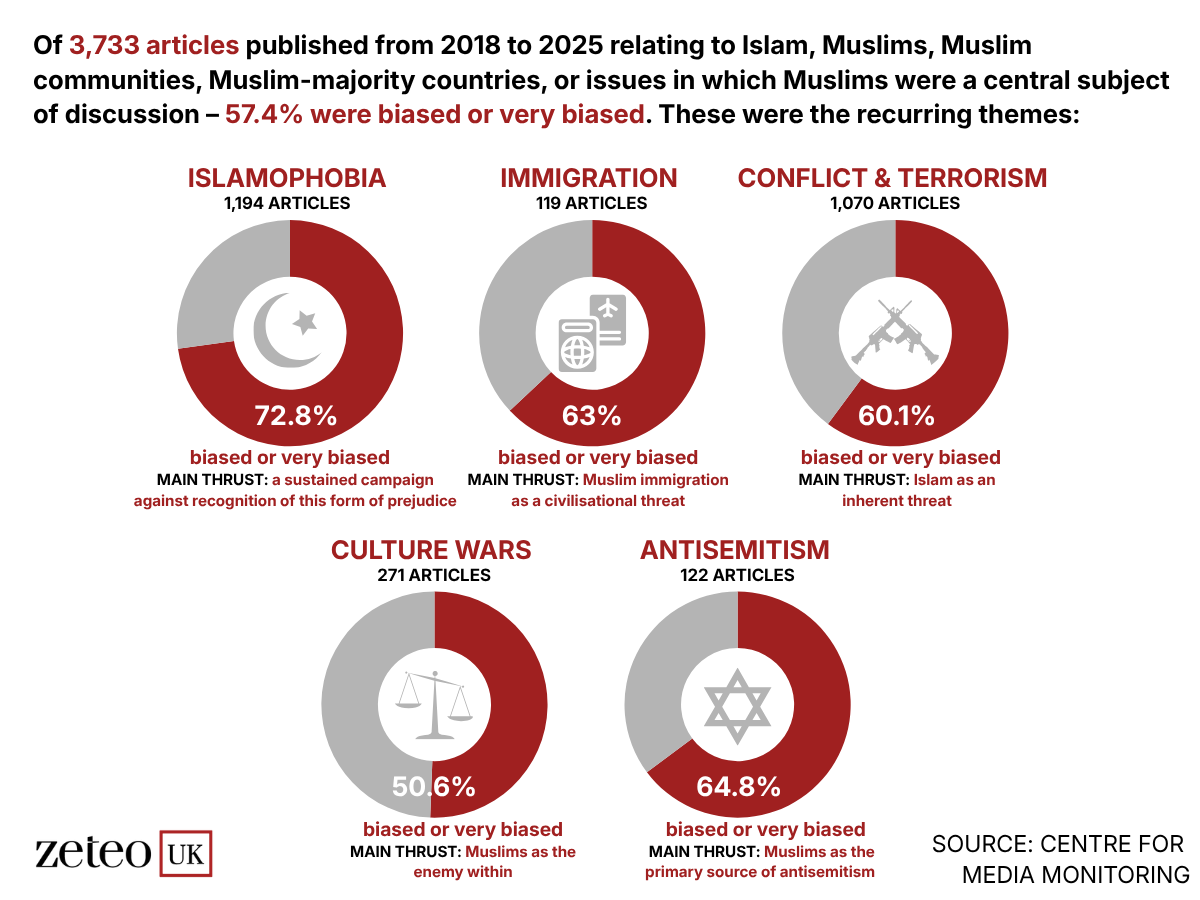
In recent years something has changed, as a new thorough and scrupulous report from the Centre for Media Monitoring (CfMM) demonstrates. Today’s Spectator obsessively mocks Britain’s minority Muslim population. The attacks come week after week, sometimes several in the same edition. The magazine detects the malign influence of Muslims in the most unexpected places. Almost anything, however random or innocent, can trigger The Spectator. Here are a few examples.
Sadiq Khan, London’s Muslim mayor, commissions a study of London landmarks. The Spectator evokes comparisons with ISIS and the Taliban.
The prime minister acknowledges an important Islamic festival. The Spectator is reduced to fury.
“Why is Keir Starmer wishing us Eid Mubarak?” demands the magazine, accusing the prime minister of “unmerited deference” and “asymmetrical multi-culturalism”.
Westminster Council approves a mosque in the former Trocadero building in Piccadilly Circus. The Spectator frames this within a narrative of “creeping desolation”, “lost opportunities”, and “moral and cultural collapse.”
One Spectator journalist reports that “pandering to the growing Muslim vote is cringy and occasionally downright dangerous.”
Another Spectator journalist goes for a country walk. He notes with pleasure that some old gates have been replaced. Then his mood darkens. Attached to the new gates are official injunctions to abide by the Countryside Code illustrated by pictures of a woman wearing a burka.
Aah! A burka!
The image arouses his rage and drives him into an agony of introspection. These pictures, he reports, are:
“a coded message saying, essentially, this: ‘You think this is your country, you sap? It is not. It is not even your country up here among the beech hangers and the silver birch and the purple ragwort and the fluttering brimstones. Even up here, it is not yours. Not any more. Get used to this new reality, quickly.”
The writer muses that the “enormous gains” made by Reform UK are “a reaction to the way in which the history, culture, lifestyle and aspirations of the indigenous population have been repeatedly bludgeoned this past quarter of a century. It is notice being given that the public has had enough: that a line in the sand must be drawn.”
The same Spectator writer, Rod Liddle, dismisses the London borough of Tower Hamlets, home to a substantial Bangladeshi Muslim community, as a “fly-blown satrapy” and “suburb of Sylhet”.
Mr Liddle writes a Spectator article carrying the sub-headline “There’s not enough Islamophobia in the Conservative Party.” After an outcry The Spectator changes the headline.
One only has to imagine the career-ending consequences, not just for the writer but also the editor, and indeed the magazine itself, that would (rightly) have followed had a Labour magazine asserted that “there’s not enough anti-semitism in the Labour Party.”
Not just Muslims get trashed. Anyone who dares to speak up in their defence places themselves in the line of fire. (During a witch-hunt, you become a witch yourself if you protect them.)
Church of England bishops criticise Tommy Robinson’s racist “Unite the Kingdom” march, with its virulent anti-Muslim message. The Spectator lacerates them for “an epic disregard for the people in this country who would call themselves Christian and wish for the United Kingdom to remain a Christian country and a concomitant preference for the belief systems of anybody who actually isn’t Christian.”
Manchester Cathedral opens its doors to Muslims for an iftar, the ceremonial breaking of the religious fast during Ramadan. A generous ecumenical gesture if ever there was one. The Spectator grants space to a writer who denounces this gesture of friendship as an “extraordinary act of negligence” and “cultural cringe.”
Another writer tells Spectator readers that the ideology of the ISIS terror group “emerged wholesale from the deserts of 7th century Arabia.” As any serious scholar will tell you, ISIS is a grotesque mutation of Islam.
“If international law says Khamenei should still be in place,” muses a Spectator writer in the wake of the US/Israeli assault on Iran, “maybe international law deserves to be detonated along with him.”
The magazine’s extensive output about Islam emerges from a coherent ideological viewpoint. Muslims are invaders. They don’t belong in this country. They don’t share our values and they threaten our public spaces. Any civic engagement by Muslims in Britain is suspect and should be resisted.
The Centre for Media Monitoring’s report documents how Spectator writers demonstrate or fill out this thesis through misrepresentation, fabrication, vulgar abuse and conspiracy theories
Many observers would regard such coverage as Islamophobic. Not The Spectator, which refuses to frame Islamophobia in its accepted sense as an irrational fear, hatred or prejudice directed at Muslims for being Muslim. Instead, it turns the concept on its head. The Spectator argues that Islamophobia is a weapon cynically deployed by “Islamists” (and their allies within the progressive establishment) to silence legitimate criticism and to curtail free speech. This argument serves a dual purpose.
First, it insulates The Spectator (and other anti-Muslim outlets) from charges of bigotry, hate speech and discrimination against a minority. Second, it repositions Muslims who experience prejudice or hatred as bad faith actors rather than victims.
Finally, it presents Spectator writers (and anyone else who derides Islam) as the wronged party.
One Spectator columnist mocks Muslims who complain about prejudice for their “dainty sensibilities.” Another puts complaints of Islamophobia down to attention seeking: “there are incentives for Muslim commentators to complain about persecution, because it gets the hits and will be tweeted by MPs keen to be taking this problem seriously.” This tactic will not work, he warns, because it “feeds popular resentment towards the Muslim minority” who are “seen as ungrateful.”
It’s tempting to link the magazine’s obsessive hostility towards Islam to the change of ownership which resulted from the collapse of the Barclay Brothers newspaper empire in 2024. The new proprietor, Paul Marshall, controls an array of media outlets. All of them attack, misrepresent and promote conspiracy theories about Islam. His television channel GB News is the worst culprit.
Last year a CFMM study found that GB News mentioned Muslims or Islam 17,000 times, accounting for almost 50% of all mentions on UK news channels (by contrast BBC and Sky accounted for 32% and 21% respectively.) According to CFMM, GB News presented Muslims and Islamic beliefs as part of a conspiracy to undermine the British way of life. As with The Spectator, GB News regularly ridiculed (and denied) the concept of Islamophobia. Recently the third leg of Paul Marshall’s media empire, the Unherd website, dedicated thousands of words to an article headlined “The Plot for a British Caliphate.”
The anti-racist campaign group Hope Not Hate explored Mr Marshall’s private X account. It revealed that he had “liked” posts promoting anti-Muslim sentiments and far-right conspiracy theories. One of them read “It is just a matter of time before civil war starts in Europe. The native European population is losing patience with the fake refugee invaders.” Another was found to have said: “If we want European civilization to survive we need to not just close the borders but start mass expulsions immediately.”
Marshall insisted that these posts did not represent his views. Spectator columnist Douglas Murray denounced Hope Not Hate as a “hate group” while Fraser Nelson (then Spectator editor) accused the anti-racist organisation of running a “smear campaign.”
To be fair, the new CFMM study shows that Paul Marshall cannot be held responsible for The Spectator’s unhinged fixation on Islam: this dates back long before he bought the paper. It’s impossible to identify the exact moment the magazine changed into an obsessive anti-Muslim crusader.
When I first wrote for The Spectator in the 1990s there were certain columnists, notably the Greek millionaire “Taki” Theodoracopulos, who made racist and other types of offensive remarks. They might be directed at West Indians, Jews, Arabs, women, gays and for that matter any minority. Taki even praised Greece’s fascist Golden Dawn as “good old-fashioned patriotic Greeks.” The magazine defended Taki on the grounds that “Our readers like diversity and well-written pieces that they disagree with. We have no party line.”
The Spectator was saying that there was no problem with running an article in support of a political party which copied the Nazis (Holocaust denial, blood and soil rhetoric, Nazi salutes etc) and celebrated Adolph Hitler. The magazine got away with it in part because Taki (later to be jailed for drug use and recently given a 12-month suspended sentence for attempted rape) was seen as a court jester rather than a serious political writer who represented the views of the paper.
The Spectator may even have benefitted from such outbursts. They provided free publicity for the magazine and made it feel provocative and interesting. Looking back on it, however, the Golden Dawn moment, and other episodes like it, feel a great deal more sinister than they looked at the time. (I have to declare that I continued to write for the magazine as an occasional contributor after that episode.)
Five years ago, academic and media analyst Brian Cathcart wrote this: “today’s Spectator is a far-right organ of intolerance.”
He added: “Letting The Spectator into your home, in other words, is for me pretty much like decorating your coffee table with a book about race by Oswald Mosley.”
CFMM’s study of the magazine proves, in grim detail, that Cathcart was right. In recent years, Muslims have become the primary (though certainly not the only) target of Spectator bigotry. Three recent examples demonstrate how far the paper has moved from the tolerant liberal conservatism which characterised the first 150 years of the magazine’s history.
Shortly after October 7, Spectator columnist Douglas Murray toyed with the idea of Israeli ethnic cleansing in Gaza: “Maybe they will finally put an end to this insoluble nightmare, raze Hamas to the ground, or clear all Palestinians from that benighted strip,” he mused, “it could be a good time to do it.”
Mass forcible population transfer is a war crime under the Fourth Geneva Convention. It was shocking to find such an article in a respectable British publication. At the very least, The Spectator could have made an editorial intervention, clarifying that it considered ethnic cleansing of the kind described by Murray to be wrong. I can find no evidence that it did so.
A similar proposition was put forward at roughly the same time in an article for Fathom, house journal of the pro-Israel lobby group Bicom. The editors of Fathom, however, made it clear they disagreed with the author, a retired Israeli general called Giora Eiland.
This is the territory The Spectator has chosen to occupy, as became clear when the Tory MP Katie Lam was awarded “Newcomer of the Year” at last year’s Spectator “Parliamentarian of the Year” awards. Lam had made modest headway in Parliament since winning the Weald of Kent in the 2024 general election. Shortly before the awards, however, she made headlines by calling for large numbers of legally settled families to be deported from Britain. Such a move, she claimed, would help to ensure that the UK is “culturally coherent”.
Lam’s comment would have gone down well with the Monday Club, a Tory pressure group founded to give support to white Rhodesia after Harold Macmillan turned against it in the 1960s. It is an ominous portent that the Tory house magazine should have awarded her a gong in the wake of remarks in which she advocated even more extreme policies than Enoch Powell had done in 1968.
The Spectator, which half a century ago accused Enoch Powell of toying with the “politics of hatred”, has been steadily rebuilding his reputation. Last October Douglas Murray praised what he saw as Powell’s prophetic vision. In May this year, The Spectator ran the headline “It’s time to uncancel Enoch Powell” above an article which announced that Powell “had a view of the British polity, values and way of life with which many Britons to this day feel they identify, and that is not least what establishes him as one of the country’s greatest conservative influences.” The author, Enoch Powell’s biographer Simon Heffer, predicted that “The attempt to vilify and to cancel him, coming in a dangerous period where freedom of speech and expression seemed more under threat in Great Britain than at any time since the 17th century, will prove temporary. His true importance will survive.”
This case that freedom of speech and expression is under attack is made frequently by Spectator writers. It’s true that the magazine (with revealing exceptions such as Mosley’s Blackshirts) has traditionally valued freedom of speech and expression. This is no surprise. The great liberal philosopher and free speech theorist John Stuart Mill was a Spectator contributor.
Mill wrote: “there ought to exist the fullest liberty of professing and discussing, as a matter of ethical conviction, any doctrine, however immoral it may be considered.” This does not mean that Mill thought the expression of all opinions should be free from censure. That includes the freedom to censure the publication for its preoccupation with Muslims. It includes the freedom to regard Spectator articles as Islamophobic, stupid, bigoted, racist, ignorant and irrational.
Besides, it is nonsense to say that writers in The Spectator are in any danger of losing their free speech. Their opinions on Islam are the opinions of at least half of the British ruling elite, as represented by the Conservative Party and Reform UK, along with a mass of right-wing media outlets: The Telegraph, The Times, The Sun, The Daily Mail, The Daily Express – or GB News, where Tory and Reform politicians are paid large sums to broadcast their opinions to the nation.
The Spectator has a tradition of support for more often than not, unfashionable or minority causes. When it comes to British Muslims, The Spectator mobilises free speech in favour of the majority against a beleaguered minority. This would have troubled Mill, who was careful to warn against the stifling effect on free speech resulting from what he called the “unmeasured vituperation employed on the side of prevailing opinion.”
More than that, Mill stressed that “opinions lose their immunity, when the circumstances in which they are expressed are such as to constitute their expression a positive instigation to some mischievous act.”
There is a provable link between Islamophobia and violent assaults on Muslims. Try reading Anders Breivik’s manifesto before he massacred 77 Norwegians in a crazed assault, motivated by white supremacist ideologies and the great replacement theory.
Three British Muslims have been murdered, on account of being Muslim, in the last 15 years. Others get abused, targeted, beaten up. They fear going out at night. Last April a man was jailed for 13 years after raping a Sikh woman because he believed she was Muslim. At least 28 British mosques were attacked in the first four months of 2026. In June this year, there were an average of four to five Islamophobic attacks a week, and over 40% of these were arson or firebombing attacks. As this article was being prepared five people were injured during an attack on a mosque near Edinburgh. Meanwhile the home of Salma Yaqoob, a prominent local politician and NHS worker, was subject of what appears to have been a targeted arson attack.
I don’t think The Spectator can be accused of directly provoking violence against Muslims. Its genteel and middle-class readers might be further enraged by the inflammatory rhetoric of Spectator writers, but they are not usually street-fighting thugs. Instead, the magazine has played a role in making racism and bigotry permissible across much mainstream British media and wider public and political discourse. This means that The Spectator plays a particularly significant – and pernicious – role in fermenting Islamophobia. The magazine lies at the heart of Britain’s media/political nexus. Its parliamentarian awards and summer party are the Cheltenham Festival and Royal Ascot of the Westminster social season. Its stature confers respectability and helps regularise what can, and what cannot, be said. Its example liberates more demotic publications to publish their own fabrications and dangerous lies about British Muslims.
For almost 200 years The Spectator stood for a tradition of good writing and civilised and often bravely heretical discourse. It used its voice to articulate, and sometimes to lead, our national struggle for tolerance. Today, as it approaches the 200th anniversary of its foundation by Robert Rintoul, The Spectator has become one of the most influential British media apologists for bigotry, hatred and racism: an upmarket version of GB News. For those of us who loved, revered and were guided by the old Spectator this is a national tragedy. British Muslims have every reason to feel threatened and intimidated by such rancid, repetitive, irrational and apparently uncontrollable hostility from a hugely respected magazine at the heart of the British establishment.
Peter Oborne is a former Political Editor of The Spectator, and will be a regular contributor to Zeteo UK from September.
This piece was first published as the forward to the report by the Centre for Media Monitoring’s report, ‘No mere Spectator: Anti-Muslim Hostility in Britain’s Oldest Political Magazine’.
More from Zeteo UK:


Let’s not forget that Douglas Murray is a close friend of Israel’s President Isaac Herzog, who famously stated “there are no innocents in Gaza” in October 2023, so it might not be a coincidence Douglas appears to be complicit in this seemingly coordinated Islamophobic harassment campaign being waged through the right wing media. Surely it’s a hate crime and the media regulators should investigate it?
Am delighted that Peter Oborne is part of the Zeteo UK team. Have seen him speak a few times. He's not only an extremely well informed and brilliant writer he's a thoroughly nice man.